






















B.E. Civil

B.E. Civil

Course Duration 4 years (8 Semesters)
Faculty School Of Engineering
No of Seats 144

96% Employment Rate

are in work or further study within 6 months of graduating

Whitehouse Placement Cell

1000+ Graduates

are in work or further study within 6 months of graduating

Alumni Network

20+ Years of

20+ Years of

About Us

Bachelor of Civil Engineering

The Bachelor of Civil Engineering is a four-year, eight-semester program totaling 144 credit hours, affiliated with Purbanchal University.
The curriculum blends theory and hands-on practice across infrastructure-related fields such as water supply, sanitation, irrigation, hydrology, engineering materials, fluid mechanics, soil mechanics, foundation engineering, geology, transportation engineering, and hydropower engineering.
Civil engineering is often described as the oldest and broadest engineering discipline, covering the design, construction, and maintenance of the built environment – roads, bridges, dams, airports, sewerage systems, pipelines, buildings, and railways – across both public and private sectors.
Core sub-disciplines include geotechnical, structural, transportation, water resources, environmental, and earthquake engineering, as well as urban planning.

Course Structure

S.N. Course Code Subjects Total
1 BSH1001 Mathematics – I 100
2 BSH1003 Chemistry 125
3 BCI1001 Applied Mechanics – I (Statics) 100
4 BCI1002 Civil Engineering Materials 125
5 BEL1001 Basic Electrical Engineering 75
6 BME1001 Engineering Drawing – I 100
7 BME1002 Workshop Technology 50
Total 675
S.N. Course Code Subjects Total
1 BSH3008 Mathematics-III 100
2 BCI3006 Strength of Materials 125
3 BCI3007 Fluid Mechanics 125
4 BCI3008 Survey I 150
5 BCI3009 Engineering Geology 125
6 BEC3008 Basic Electronics Engineering 75
7 BCE3001 Computer Programming 125
Total 825
S.N. Course Code Subjects Total
1 BCI5016 Soil Mechanics 125
2 BCI5017 Survey Camp ** 100
3 BCI5018 Theory of Structure-II 125
4 BCI5019 Water Supply Engineering 125
5 BCI5020 Transportation Engineering-I 125
6 BCI5021 Engineering Hydrology 125
7 BCI5022 Design of Steel and Timber Structure 100
Total 825
S.N. Course Code Subjects Total
1 BCI7029 Design of reinforced concrete structure 125
2 BCI7030 Hydropower Engineering 125
3 BCI7031 Estimation and valuation 100
4 BCI7032 Civil Engineering Project I 50
5 BCI7033 Safety Engineering 50
6 BCI7034 Construction Project Management 100
7 BCI78– Elective-I 100
Total 650

NCCs and Trainings

Loading Trainings...

Careers Outcomes

Loading Careers...

Objectives

Objectives

1.Professional Competence
Graduates will apply fundamental and technical knowledge of civil engineering principles to analyze, design, construct, and maintain sustainable infrastructure systems.
2.Technical and Practical Skills
Graduates will demonstrate proficiency in modern engineering tools, software, laboratory practices, field techniques, and construction management applicable to real-world engineering problems.
3.Leadership and Teamwork
Graduates will work as individual professionals, team members, and leaders in multidisciplinary civil engineering environments and construction industries.
4.Ethics and Social Responsibility
Graduates will practice engineering with professional ethics, environmental consciousness, safety considerations, and commitment to societal development.
5.Research, Innovation, and Lifelong Learning
Graduates will engage in research, innovation, higher studies, and continuous professional development to adapt to evolving technologies and global engineering challenges.
6.Communication and Project Management
Graduates will effectively communicate technical information and manage engineering projects considering economic, environmental, and sustainability aspects.
7.Contribution to National Development
Graduates will contribute to the planning, design, and development of resilient infrastructure for the sustainable growth and modernization of country and the global community.

Learning Outcomes

•Infrastructure Development Capability
Plan, design, and supervise infrastructure projects that address contemporary societal and national development needs.
•Innovative Engineering Practice
Develop creative and practical engineering solutions using analytical thinking and emerging technologies.
•Construction and Resource Management
Apply effective project planning, construction management, and resource optimization techniques in engineering practice.
•Sustainable and Resilient Design Approach
Incorporate sustainability, disaster resilience, environmental protection, and climate-responsive concepts into civil engineering projects.
•Professional Growth and Adaptability
Demonstrate leadership, adaptability, and continuous learning to meet evolving challenges in the civil engineering profession.

Eligibility for admission in BE Civil Program

The candidate must have passed +2 Science/A level or equivalent (with Physics, Chemistry & Mathematics) with minimum ‘C’ Grade in Physics, Chemistry & Mathematics from any recognized academic institution with minimum 45% marks or GPA 2.00 in aggregate.

Academic Qualification

The candidate must have passed +2 Science, A Level, or equivalent from a recognized academic institution, with Physics, Chemistry, and Mathematics as subjects.

Minimum Grade Requirement

The candidate must have secured a minimum ‘C’ grade in Physics, Chemistry, and Mathematics, with at least 45% marks or a GPA of 2.00 in aggregate.

Admission Details

Scholarships Detail

Life As Student At HWIC

•

Internships Or Placement

More Placements

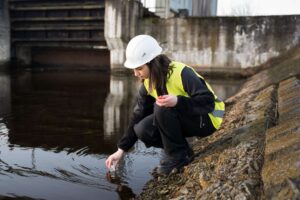
Civil engineering is a field that combines technical expertise with creative problem-solving. As civil engineers, individuals are involved in the design, construction, and maintenance of critical infrastructure such as roads, bridges, airports, and buildings. They tackle challenges related to sustainability, safety, and efficiency, ensuring that structures can withstand the test of time and serve the needs of society. Moreover, civil engineers have the opportunity to make a positive impact on the environment. With a growing emphasis on sustainable practices, civil engineers are at the forefront of developing eco-friendly solutions. They integrate green technologies, explore renewable energy sources, and implement measures to minimize environmental impact. By blending their technical skills with environmental consciousness, civil engineers contribute to a more sustainable and resilient future.

KBL
skill lab

Start Your Journey At HWIC

Er. Mukesh Shrestha

The department welcomes students into a program with a long track record of producing capable engineers and leaders who hold themselves to high ethical standards internationally. Faculty combine strong academic credentials with practical field experience, helping students both master engineering fundamentals and develop original, socially useful solutions. Regular engagement with entrepreneurs, professionals, and industry experts pushes students toward creative, industry-relevant problem solving, building on the dedication of the department’s instructors, staff, and student community.
Student Testimonial

Success Stories

Fetching Success Stories...

Samyak Moktan

combination of experienced faculties

I chose WhiteHouse and it was the best decision for me. The combination of experienced faculties, a cooperative management, advanced infrastructures, good facility of library and IT system are the remarkable identities of the college. The out of the syllabus exposure I received during my college days have shaped me to be at the present success.

Samyak Moktan

BLAS (Fellow, Kent State University, USA )

Binod Das

its been a great privilege and honor

Himalayan Whitehouse College has been a brand in education field that has proved its metal with excellent leading methods and renowned faculties. I have been associated with Whitehouse brand for a decade almost and my EMBA journey is just an extension of that journey. I must confess, its been a great privilege and honor.

Binod Das

(EMBA) National Cricket Captain, Nepal

Mr. Manoj Bhatta

pursuing expertise outside your current field

MBA at Whitehouse offers its students with a greater network of alumni, faculty, and business and community leaders. This network has been useful when beginning a job search, developing a career path, building business relationships in your current career, or pursuing expertise outside your current field.

Mr. Manoj Bhatta

BatchTopper, MBA

Class of 2013